Executive Summary
The 5:1 ratio—five positive interactions for every negative one during conflict—is one of the most rock-solid findings in relationship science. After four decades of research involving over 40,000 couples, Dr. John Gottman discovered this ratio distinguishes thriving relationships from those headed for disaster with remarkable accuracy.
Here’s why it matters: your brain’s negativity bias means negative experiences register about five times more powerfully than positive ones. It’s not fair, but it’s neurology. One criticism hits like five compliments. One dismissive eye-roll cancels out five warm touches. This neurological reality demands a strategic approach to relationships—you need to actively cultivate positive interactions to counterbalance the inevitable conflicts and frustrations of shared life.
This article synthesizes the research, neurological evidence, and practical strategies to explain why the 5:1 ratio matters, how it operates at psychological and neurological levels, and what you can actually do to achieve and maintain this critical balance.
The Emotional Bank Account: Deposits vs. Withdrawals
Your relationship is an emotional bank account. Positive interactions are deposits; negative ones are withdrawals. The 5:1 ratio keeps your account in the black.
The Research Foundation: Predicting Relationship Success
The Methodology
John Gottman’s research program started in the 1970s with systematic observation of couples in controlled settings. The methodology was brilliantly simple: videotape couples discussing their biggest disagreements, then code every single verbal and non-verbal expression into categories of positive affect (interest, affection, humor, validation, agreement) and negative affect (criticism, contempt, defensiveness, belligerence, stonewalling).
What made Gottman’s approach revolutionary was its longitudinal rigor. Seven major studies followed couples for 2 to 15 years, tracking which marriages stayed intact and happy, which endured miserably, and which ended in divorce. The research incorporated physiological measurements—heart rate, skin conductance, blood velocity—alongside behavioral observation, creating a multi-dimensional portrait of what actually happens when couples fight.
The predictive power was extraordinary. Across studies, Gottman achieved accuracy rates exceeding 90% in forecasting divorce within three to six years. One landmark 1992 study reported 93.6% accuracy. Later research across 40,000 couples claimed 94% accuracy. The primary predictor? Always the same: the ratio of positive to negative interactions during conflict.
The Magic Ratios: 5:1 During Conflict, 20:1 in Daily Life
The research revealed two distinct ratios operating in successful relationships:
During conflict discussions—when couples are actively negotiating disagreements—stable marriages maintained a minimum ratio of five positive interactions for every negative one. Partners who fell below this threshold, particularly those approaching a 1:1 ratio where negative interactions nearly equaled positive ones, showed clear trajectories toward divorce. Relationships at 0.8:1—where negatives actually outnumbered positives—represented acute crisis.
During daily life—when couples navigate ordinary routines outside conflict—successful relationships demonstrated ratios approaching 20:1. This dramatic difference reflects context: during heated arguments, both people are already in negative emotional states, so additional negativity is somewhat expected and buffered. During neutral moments, however, an unexpected negative interaction—a criticism about unwashed dishes, dismissal of a bid for attention—withdraws disproportionately from the relationship’s emotional reserves.
Relationship Outcomes by Interaction Ratio
As positive-to-negative ratios increase, both relationship stability and satisfaction rise dramatically
Validation Across Cultures and Contexts
Independent researchers have validated these findings across diverse populations. Studies examining married and cohabiting couples confirmed that the positive-to-negative ratio reliably predicted both relationship stability (intact versus separated) and satisfaction levels within intact relationships.
Cross-cultural studies extend these findings beyond Western populations, documenting that higher positive-to-negative ratios consistently correlated with relationship satisfaction across both Belgian and Japanese couples, though with some variation in how positivity is expressed.
The ratio principle even generalizes beyond romantic partnerships. Research on workplace teams found that high-performing groups maintained 5.6:1 positive-to-negative ratios during collaboration, medium-performing teams averaged 2:1, and low-performing teams exhibited nearly three negative comments for each positive one (approximately 1:3). This convergence across relationship contexts suggests a universal psychological principle governing human connection.
Why the 5:1 Ratio Matters: The Brain Science
The Emotional Bank Account
Think of your relationship as an emotional bank account. Each expression of appreciation, moment of physical affection, or act of attentive listening adds to the account’s balance. Each criticism, dismissive gesture, or withdrawal of attention draws down reserves.
Here’s the critical insight: not all transactions carry equal weight. Due to your brain’s negativity bias, withdrawals deplete the account far more than deposits replenish it. A single harsh criticism requires five expressions of appreciation to restore equilibrium.
Couples who consistently maintain high balances—those with surplus positive interactions—develop what researchers call “positive sentiment override.” Ambiguous behaviors receive charitable interpretations. Partners assume good intentions, interpret forgotten tasks as simple mistakes rather than disrespect, and extend generosity during moments of tension.
Conversely, depleted accounts produce “negative sentiment override,” where even neutral or kind gestures get interpreted through a hostile lens. Partner brings flowers? Instead of feeling appreciated, you wonder “What did they do wrong?” This toxic dynamic accelerates relationship deterioration as each person defensively guards against perceived attacks, creating self-reinforcing cycles of negativity.
The Neurological Basis: Why Your Brain Needs 5:1
Your brain is hardwired to detect threats. Negative experiences register with roughly 5 times the psychological weight of positive ones.
The Neurological Reality
The 5:1 ratio directly addresses your brain’s hardwired negativity bias—an evolutionary adaptation that prioritized threat detection over opportunity recognition. Neuroscientist Rick Hanson describes it succinctly: your brain operates like Velcro for negative experiences and Teflon for positive ones. Negative information sticks, proliferates in memory, and shapes future expectations. Positive information slides away unless deliberately reinforced through repetition.
The amygdala, your brain’s primary threat-detection system, dedicates approximately two-thirds of its neurons to identifying and encoding negative stimuli. Brain imaging studies reveal that negative images and experiences activate the amygdala within milliseconds, triggering rapid, intense neural responses. Positive stimuli require longer processing times and generate weaker neural signatures.
This asymmetry extends throughout neural networks. Negative experiences activate more extensive networks, receive more elaborate cognitive processing, and consolidate into stronger, more enduring memory traces than equivalent positive experiences.
The evolutionary logic is clear: ancestors who remained hypervigilant to threats—predators, poisonous foods, hostile strangers—survived to reproduce more successfully than those who focused on positive experiences. Modern brains inherit this ancestral bias, now misapplied to relationship contexts where your partner’s criticism registers with similar neural intensity as physical danger once did.
The 5:1 ratio represents the counterbalancing strategy. If negative interactions register with roughly five times the psychological weight of positive ones, then five positive interactions provide the necessary offset to maintain emotional equilibrium and relationship satisfaction. This isn’t arbitrary—it reflects the neurological reality of human emotional processing.
The Four Horsemen: What Kills the Ratio
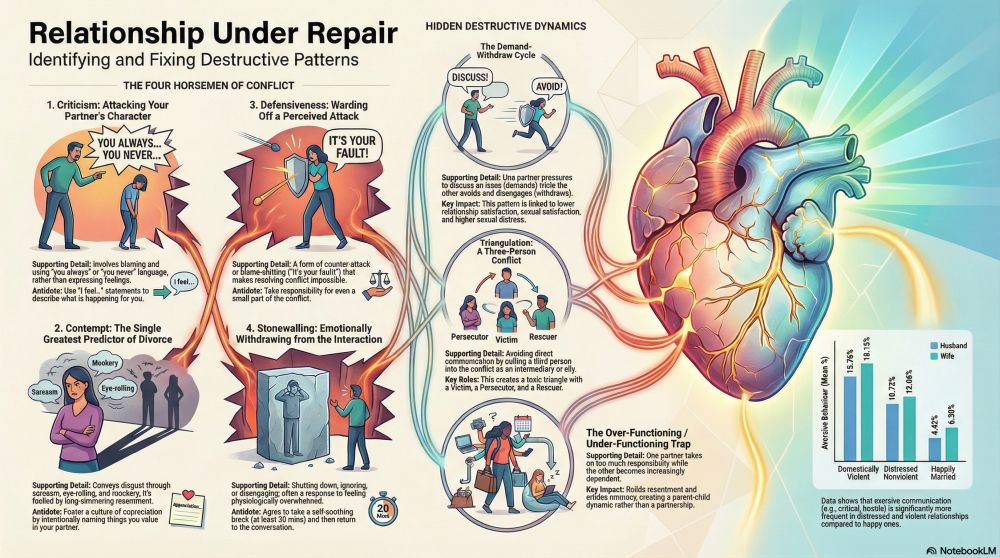
Gottman identified four negative interaction patterns—the Four Horsemen of the Apocalypse—that particularly erode relationships and predict divorce: criticism, contempt, defensiveness, and stonewalling.
Criticism transforms specific complaints into character assassinations. Rather than addressing a behavior (“I felt hurt when you forgot our anniversary”), criticism attacks the person (“You’re so self-centered, you never think about me”). This pattern initiates escalation cycles as recipients perceive fundamental threats to their identity and worth.
Contempt involves communicating from a position of moral superiority—eye-rolling, mockery, hostile humor, name-calling. Research identifies contempt as the single strongest predictor of divorce. Contempt communicates disgust and disrespect, fundamentally incompatible with the admiration and fondness that sustain intimacy.
Defensiveness typically emerges as a response to criticism, but rather than defusing tension, it escalates conflict by refusing accountability and counter-attacking. The defensive partner deflects blame—”That’s not my fault, you’re the one who…”—preventing resolution and signaling unwillingness to examine their own contribution to problems.
Stonewalling involves complete withdrawal from interaction. The stonewalling partner becomes a stone wall—unresponsive, turned away, engaged in distracting behaviors—shutting down communication entirely. This pattern usually develops after repeated exposure to the first three horsemen, when physiological flooding (racing heart, elevated stress hormones) makes continued engagement feel intolerable.
These four patterns constitute the withdrawals that devastate emotional bank accounts. The antidotes—gentle start-up (expressing concerns without blame), building fondness and admiration, taking responsibility, and physiological self-soothing—represent the deposits that restore balance.
Strategies for Implementation: Building the 5:1 Ratio
The Sound Relationship House Framework
Gottman’s Sound Relationship House provides a structure for relationship construction, comprising seven levels representing cumulative competencies:
Level 1: Build Love Maps
This means maintaining detailed knowledge of your partner’s inner world. Partners in strong relationships remain intimately familiar with each other’s current stresses, ongoing concerns, major life goals, and evolving dreams. This knowledge foundation enables appropriate emotional responsiveness because you understand the significance of events from your partner’s perspective.
Implementation involves curiosity and regular updating. Ask open-ended questions about your partner’s day, their worries, their aspirations. When they mention a project deadline, remember to follow up. When they share concerns about a family member, track developments and inquire with genuine interest. Love Maps deteriorate through neglect—relationships that began with intensive knowledge-gathering often stagnate as partners assume they know everything and stop asking questions.
Level 2: Share Fondness and Admiration
This addresses the attitudinal foundation beneath behavior. Couples maintain reservoirs of positive feelings—genuine appreciation for partner qualities, admiration for their character strengths, and fondness for their idiosyncrasies. These reservoirs buffer against contempt and create the emotional substrate for generous interpretation during conflicts.
Try the “I Appreciate” exercise: partners independently review lists of positive adjectives (thoughtful, creative, resilient, humorous) and check those describing their partner, then share selections while providing specific examples. This exercise counters the natural tendency to focus on irritating qualities and deliberately redirects attention toward the positive attributes that attracted you initially.
Level 3: Turn Toward Instead of Away
This concerns responsiveness to bids for connection—the fundamental units of emotional communication.
Bids for Connection: The Three Ways Partners Respond
Bids for connection are the fundamental units of emotional communication. How you respond matters more than how you handle major conflicts.
Bids come in countless forms: sharing a thought (“Look at this article”), requesting attention (“Can we talk about something?”), seeking physical affection (moving close for a hug), or expressing a need for support (“I had a rough day”).
Partners respond in three ways: turning toward (acknowledging and engaging positively), turning away (ignoring or missing the bid), and turning against (responding with irritation or dismissal).
The research reveals stark differences: couples who remained married turned toward their partner’s bids 86% of the time, while couples who divorced did so only 33% of the time. This pattern proves more predictive of relationship longevity than how couples handle major conflicts, because everyday responsiveness or lack thereof accumulates into profound effects on intimacy and trust.
Small Things Often: The Real Secret
Grand romantic gestures—anniversary trips, expensive gifts, elaborate date nights—matter far less than small, consistent acts of connection performed daily. Trust and intimacy build through accumulated micro-moments rather than occasional spectacles.
Small Things Often: Daily Rituals That Build Trust
Relationship satisfaction depends more on daily micro-moments than occasional grand gestures
Research on “sliding door moments” illustrates this principle. Picture returning home after an exhausting day, looking forward to a solo run to decompress. As you lace your shoes, you notice your partner sitting silently with a sad expression. The sliding door moment: do you pretend not to notice and slip out, or do you pause your plans, sit down, and ask “What’s wrong?” These tiny choices—whether to turn toward or away in unremarkable moments—determine whether deep trust develops or erodes.
Effective daily rituals include:
Morning rituals: Share coffee before the day begins. Stay in bed slightly longer for physical closeness. Exchange a meaningful kiss before departing, including at least one specific detail about what each person’s day holds. This practice maintains connection across the day’s separation and signals ongoing interest in each other’s lives.
Departure and homecoming rituals: Make partner contact the first priority when leaving or returning home, before checking phones, starting chores, or engaging with children. A warm, affectionate greeting communicates “You matter most to me” and sets positive emotional tone.
Two-minute daily check-ins: Research demonstrates that two minutes of undistracted communication carries more relationship benefit than an entire unfocused week together. This brief window—phones away, TV off, full attention given—allows partners to share day highlights and maintain current knowledge of each other’s worlds.
Evening sharing and bedtime cuddles: Dedicate time before sleep for day debriefing and physical intimacy. Even if partners have different sleep schedules, the partner retiring earlier receives the same attention—ensuring daily connection remains inviolable regardless of logistical constraints.
Gratitude and Appreciation Practices
Systematic gratitude practices amplify positive interactions and shift attention toward partner strengths. Research demonstrates measurable improvements in relationship satisfaction after just 14 days of consistent gratitude work.
The Weekly Gratitude Share: Once weekly, partners sit together without distractions and each shares five specific things they appreciated about their partner that week, one thing they’re grateful for about the relationship overall, and one thing they’re looking forward to together. Specificity matters enormously—”Thank you for taking out the trash without being asked” carries more impact than generic “Thanks for being helpful”.
The Three Good Things exercise: Each partner journals three positive relationship moments daily, then shares these aloud before bed. Examples: “We laughed together while making dinner,” “You texted to check on my stressful meeting,” or “We held hands watching TV”. This practice trains attention toward the positive micro-moments that otherwise disappear unacknowledged.
Written gratitude formula: “When you [specific observable action], I felt [emotion]”. Example: “When you went grocery shopping even though you were exhausted, I felt cared for and supported.” This format provides positive reinforcement by linking partner actions to your emotional responses, demonstrates you notice their efforts, and creates motivation for future similar behaviors.
Research indicates gratitude effects emerge within two to three weeks of consistent practice. Couples report increased intimacy, perceived support, and overall satisfaction as gratitude becomes habitual.
Conflict Management: Maintaining Ratios Under Stress
The 5:1 ratio proves most critical—and most difficult to maintain—during conflict when both partners occupy heightened negative emotional states. Several evidence-based strategies help:
Gentle start-up: Raise concerns without criticism or contempt. Instead of harsh accusations (“You never help around here, you’re so lazy”), use “I feel” statements: “I feel overwhelmed managing all the household tasks. Could we discuss dividing responsibilities more evenly?” Research demonstrates that 96% of conversation outcomes can be predicted from the first three minutes—harsh starts almost invariably lead to harsh endings.
Repair attempts: Function as conversational circuit breakers, preventing escalation. Repair attempts take numerous forms: humor (“We’re both being ridiculous right now, aren’t we?”), direct meta-communication (“I’m feeling defensive—could you rephrase that?”), apologies (“My reaction was too extreme, I’m sorry”), or requests to pause (“I need things to be calmer now”).
The critical factor: both making repairs and accepting them when offered. Partners who ignore or reject repair attempts allow conflicts to spiral. Couples who recognize and respond to repairs preserve connection even during disagreement.
Active listening and accepting influence: Demonstrate genuine curiosity about your partner’s perspective rather than defending your position. The goal shifts from winning to understanding—asking clarifying questions, reflecting back what you hear, acknowledging your partner’s feelings as valid even if you disagree with their conclusions.
Finding the dream within the conflict: Many recurring arguments aren’t actually about the surface issue—forgotten chores, differing spending preferences, competing social plans. Beneath these conflicts lie deeper concerns about feeling valued, maintaining autonomy, or pursuing meaningful life goals. When you understand that disagreement about vacation plans actually reflects one person’s deep need for adventure and the other’s desire for predictable security, you can address the real issue and find creative compromises honoring both needs.
Practical Application: A 30-Day Implementation Plan
Couples seeking to improve their interaction ratio can follow a graduated approach that builds sustainable habits:
Week 1 (Days 1-7): Foundation
- Begin daily evening appreciation: each partner shares one specific thing they appreciated that day
- Practice turning toward: consciously notice three bids from your partner daily and respond with full attention
- Institute one morning or bedtime ritual (kiss before leaving, two-minute check-in, bedtime cuddle)
Week 2 (Days 8-14): Expansion
- Continue daily appreciation (now aim for two specific appreciations each)
- Add one surprise gratitude text or note daily
- Practice one gentle start-up: raise a concern using “I feel” language rather than criticism
- Begin tracking positive and negative interactions to develop awareness of current ratio
Week 3 (Days 15-21): Deepening
- Continue all previous practices
- Add weekly Gratitude Share session (five appreciations, one overall gratitude, one forward-looking excitement)
- Practice one repair attempt during disagreement
- Create one new daily ritual of connection
Week 4 (Days 22-30): Integration
- Maintain all established practices
- Write and read aloud a gratitude letter to your partner
- Review tracking data to assess ratio progress
- Identify which practices feel most sustainable and meaningful to continue long-term
This graduated approach allows couples to build competency and see early results before adding complexity. Most couples notice meaningful shifts within two to three weeks as the accumulated positive interactions begin counterbalancing negativity and restoring goodwill.
Limitations and Nuances
The 5:1 ratio, while robust, requires contextual understanding. Some research reveals that prediction accuracy diminishes when equations derived from one sample get applied to independent populations. This suggests the ratio operates as a general principle rather than a precise diagnostic tool—useful for understanding relationship dynamics and guiding intervention but insufficient as standalone predictor of individual couple outcomes.
Cultural variation also requires consideration. While the positive-to-negative ratio principle held across different cultures, the specific behaviors constituting “positive” interactions showed cultural variation. What registers as appreciation or affection differs across cultures.
The ratio principle does not advocate eliminating all negativity. Healthy relationships require truth-telling, which sometimes involves negative information about behaviors requiring change. The key distinguishes between constructive negative feedback (gentle start-up expressing genuine concerns) and destructive negativity (criticism, contempt, defensiveness, stonewalling).
Finally, the “small things often” principle doesn’t diminish the value of grand gestures—anniversaries, vacations, significant gifts. Rather, research indicates these major events matter primarily when they crown a foundation of daily positive micro-moments. The vacation provides peak experience, but ongoing relationship satisfaction depends more on whether partners respond to bids for connection each ordinary day.
Conclusion: The Cumulative Power of Positive Interactions
The 5:1 positive-to-negative interaction ratio represents far more than a numerical guideline—it reflects fundamental truths about human neurology, emotional processing, and relationship dynamics. Decades of longitudinal research across tens of thousands of couples consistently demonstrates that this ratio distinguishes thriving relationships from failing ones.
The principle’s power lies in its specificity and actionability. Unlike vague advice to “communicate better” or “be kinder,” the 5:1 ratio provides concrete guidance: for each moment of criticism, dismissal, or withdrawal, you must generate five moments of appreciation, affection, attention, or support to maintain relationship health. This ratio directly addresses the neurological reality that negative experiences register with approximately five times the psychological intensity of positive ones.
Implementation requires neither extraordinary skills nor dramatic life reorganization. The evidence consistently points toward small actions performed consistently: responding when your partner shares a thought, expressing specific appreciation daily, maintaining rituals of connection, practicing gentle start-ups during conflict, and making repair attempts when tensions rise. These micro-behaviors accumulate into profound effects on intimacy, trust, and relationship satisfaction—far exceeding the impact of occasional grand gestures.
The 5:1 ratio offers hope for struggling relationships while providing preventive guidance for healthy ones. Couples approaching concerning 1:1 or 0.8:1 ratios can reverse trajectories through committed practice of positive interaction strategies, often seeing meaningful improvement within weeks. Meanwhile, couples already functioning well gain understanding of what makes their relationship work and how to preserve their bond through inevitable stresses and transitions.
Ultimately, the research delivers an empowering message: relationship quality doesn’t depend on personality compatibility, shared interests, or good fortune. It depends on daily choices—whether to turn toward or away, express appreciation or take for granted, respond with curiosity or contempt. The 5:1 ratio provides the roadmap for making those choices wisely, consistently, and with full awareness of their cumulative power to create lasting love.
Start today. Notice one bid for connection and turn toward it fully. Express one specific appreciation. That’s two deposits in your emotional bank account. Do it again tomorrow. And the day after. Small things, done often, change everything.