Executive Summary
Here’s what the research tells us: women play a surprisingly pivotal role in determining whether fights escalate or get resolved. Studies show that women try to repair conflicts more often than men, but they also experience more distress when those attempts don’t work. Over four decades of research analyzing more than 3,000 couples has identified specific, concrete strategies that actually make a difference. This article brings together findings from dozens of studies to give you practical, science-backed techniques for reducing arguments and building connection.
The Science of Gender-Specific Conflict Dynamics
Women’s Unique Position in Conflict Cycles
Research reveals some fundamental differences in how men and women approach conflict. Women tend to be more emotionally expressive and more likely to engage with conflict rather than avoid it. Paradoxically, this puts women in the position of being both the ones who escalate and the ones who repair.
Here’s the challenging part: women are generally more receptive to repair attempts, but they also become more emotionally rigid when their own repair efforts go unacknowledged. It creates a vulnerability—women who keep trying to fix things without getting any reciprocal effort from their partners end up in worse emotional states, which can eventually lead to the relationship ending.
The Emotional Flooding Phenomenon
Women experience emotional flooding—that physiological overwhelm during a fight where your heart races, your thoughts scatter, and you can’t think straight—at rates comparable to or higher than men. When you’re flooded, your cognitive function drops dramatically. You literally can’t think rationally. That’s why having conscious de-escalation strategies ready to go is so important. Studies show that emotional intelligence training significantly reduces these flooding incidents and improves how conflicts play out.
20 Evidence-Based Strategies for Women
Foundational Mindset Shifts
1. Practice Pre-Conflict Mindfulness
Research shows that mindfulness training reduces destructive conflict behaviors by 40-45% for women. Just 10-15 minutes of daily mindfulness practice builds your emotional regulation capacity before conflicts even start. Women who score higher on mindfulness measures use significantly fewer escalation strategies and report greater relationship satisfaction.
You’re essentially building your emotional muscles when things are calm, so they’re stronger when you need them.
2. Recognize the “Choice Point”
Neuroscience confirms that a 6-second pause between trigger and response gives your prefrontal cortex (the rational part of your brain) time to override your amygdala’s fight-or-flight reaction. You can create this pause by recognizing the physical signs that conflict is escalating: increased heart rate, muscle tension, that hot feeling in your chest.
Six seconds. That’s all it takes to shift from reactive to responsive.
3. Build Positive Sentiment Override
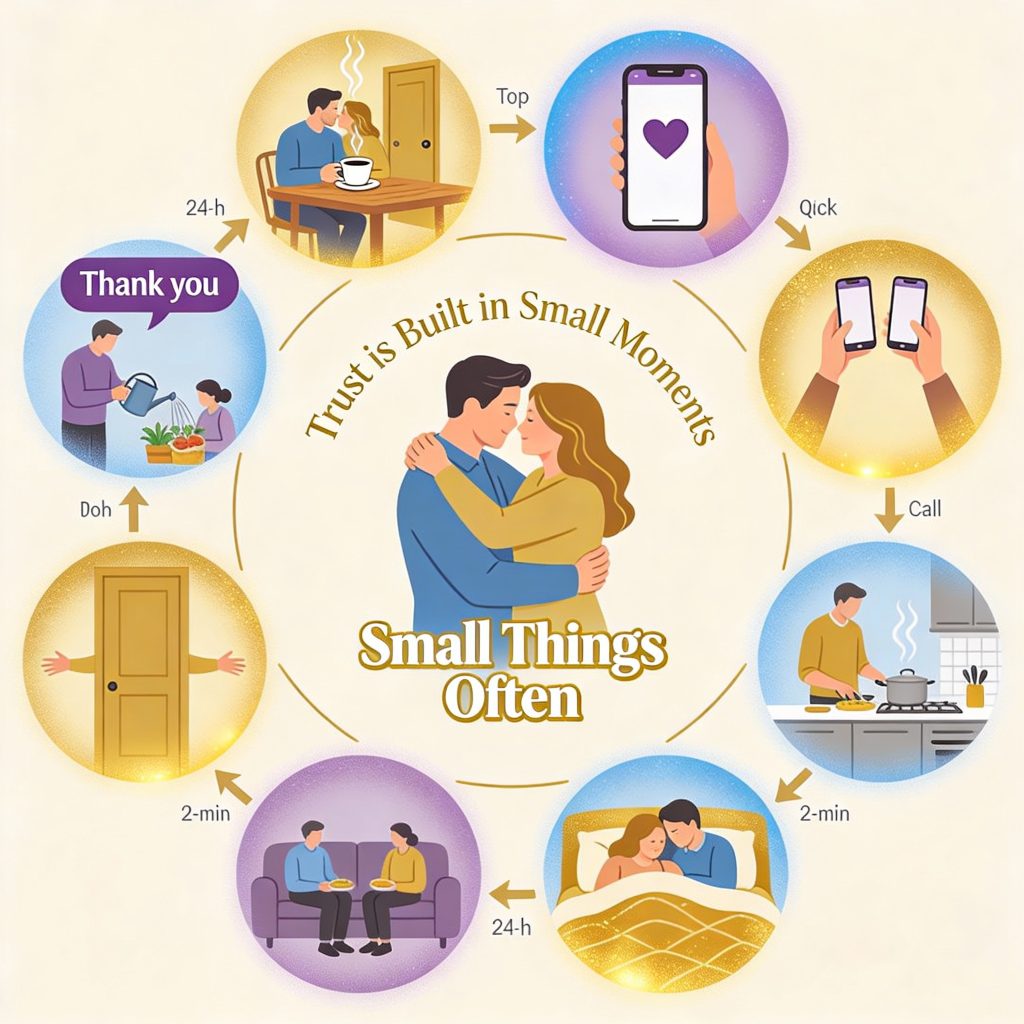
One of the most important findings from decades of research: couples need a 5:1 ratio of positive to negative interactions to successfully repair after conflicts. Think of it as an emotional bank account. You need to make regular deposits—daily expressions of fondness, appreciation, admiration—so there’s something to draw from when conflicts happen.
You can’t wait until you’re fighting to start being kind. The foundation has to already be there.
The 5:1 Positive-to-Negative Ratio
The magic ratio: 5 positive interactions for every 1 negative interaction
Strategic Communication Techniques
4. Initiate the “Voice Strategy”
Research identifies “voice” (active constructive communication) as the most effective conflict response for women. This means directly expressing your concerns while maintaining respect and proposing collaborative solutions. Women using voice strategies show higher psychological well-being and relationship satisfaction compared to those who stay silent (loyalty), complain to others (neglect), or threaten to leave (exit).
Speaking up doesn’t make you difficult. It makes you healthy.
5. Employ “I” Statements with Specificity
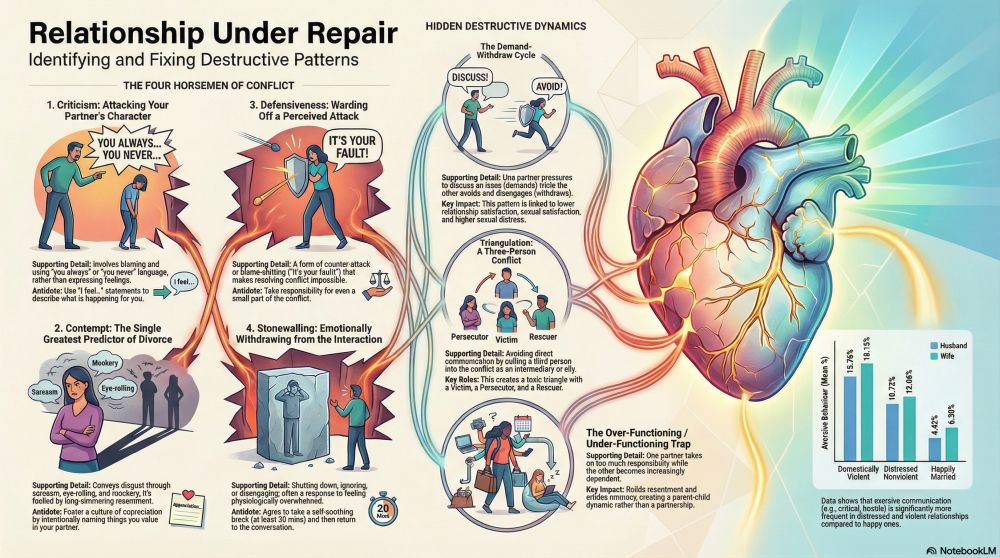
Replace “You always…” or “You never…” with “I feel [emotion] when [specific behavior] happens because [impact].” Clinical studies show this reduces defensive responses by 60-70%.
For example: Instead of “You never help around the house,” try “I feel overwhelmed when the dishes pile up because I end up doing them alone every night, and I’m exhausted.”
The specificity prevents your partner from feeling globally attacked.
6. Use Tag Questions Strategically
Research on gendered communication reveals that women naturally use more tag questions (“isn’t it?”, “right?”, “don’t you think?”). This is often seen as uncertain or weak, but it doesn’t have to be. Reframe them as collaborative bridge-building: “This matters to both of us, doesn’t it?” transforms a potential weakness into alliance-building.
7. Deploy the “Two-Minute Rule”
Agree that each person speaks uninterrupted for two minutes while the other practices reflective listening. Studies show this increases felt understanding by 80% and prevents those awful interruption spirals that make conflicts worse.
Set a timer if you need to. Two minutes of genuine listening can change everything.
De-Escalation Interventions
8. Initiate Repair Attempts Early
Women try to repair conflicts more often than men, but timing is everything. Research shows that repair attempts made within the first three minutes of escalation have 3x higher success rates than attempts made later. Early signals include humor, affectionate touch, or direct statements like “I don’t want to fight with you.”
Don’t wait until things have blown up. Repair early and often.
9. Use Specific, Proven Repair Phrases
Laboratory research has identified the most effective repair attempts. Women who use these specific phrases rather than vague appeasement show higher success rates:
- “I feel blamed. Can you rephrase that?”
- “I need to finish my point. Please let me continue.”
- “I’m sorry. Let me start over.”
- “You know I love you.”
- “Let’s take a break and come back to this.”
- “Can we try that again? I didn’t mean it that way.”
10. Apply Affiliative Humor
A study of couples in conflict found that affiliative humor—jokes to reduce tension, playful banter, gentle teasing—increased relationship satisfaction and closeness after fights. Crucially, aggressive humor (sarcasm, mocking, cutting remarks) had the opposite effect.
Use inside jokes or gentle, self-deprecating humor that brings you together rather than driving you apart.
11. Deploy Physical Affection Strategically
Research confirms that non-sexual physical touch—a hand on the shoulder, a brief hug—during conflict actually reduces stress hormones and physiological arousal. Women initiating supportive touch at peak tension can break escalation cycles.
But timing matters. The touch must feel genuine, not controlling or dismissive.
Emotional Regulation Strategies
12. Practice Physiological Self-Soothing
When your heart rate exceeds 100 beats per minute during a fight, your cognitive function declines significantly. You’re literally too flooded to think clearly. Women should take a 20-minute break when flooded, using techniques like diaphragmatic breathing (the 4-7-8 technique: breathe in for 4, hold for 7, exhale for 8) or progressive muscle relaxation.
Research shows this returns you to physiological baseline and prevents saying things that will require repair later. Twenty minutes. Not two. Your nervous system needs that time.
13. Build Emotional Intelligence Specifically
Perceived Emotional Intelligence (PEI) training shows stronger effects for women than men in reducing marital conflict. Focus on accurately identifying and labeling emotions—both your own and your partner’s. Women with higher PEI use significantly more positive conflict resolution strategies and experience less emotional flooding.
The better you can name what you’re feeling, the less power it has over you.
14. Implement the “Gentle Start-Up”
Here’s a sobering statistic: 96% of conflicts that begin with harsh start-up—criticism, contempt, blame—end negatively. The formula for gentle start-up: “I feel [emotion] about [specific situation] and I need [positive need].”
For example: “I feel anxious about our finances and I need us to sit down together and make a budget.”
Women using this approach shift from complaint to constructive request.
Cognitive Reframing Approaches
15. Adopt a “Team Mindset”
Frame conflicts as “us vs. the problem” rather than “me vs. you.” Brain imaging studies show this perspective shift activates neural circuits associated with collaboration rather than threat response.
Explicitly state it: “We’re on the same team here. Let’s figure this out together.” It sounds simple, but it literally changes how your brain processes the conflict.
16. Practice Temporal Distancing
When emotions peak, mentally project forward six months: “Will this matter in six months?” Research on emotional regulation shows this technique reduces immediate emotional intensity by 40-50%, allowing rational processing.
Women report this strategy as particularly effective for de-escalating what they describe as “small issues that trigger large reactions.”
17. Challenge Catastrophizing Thoughts
Catastrophic thinking—”This means he doesn’t love me,” “Our marriage is falling apart,” “This always happens”—is a primary driver of conflict escalation for women. Practice thought records: identify the thought, examine evidence for and against it, generate balanced alternatives.
Your thoughts aren’t facts. They’re interpretations, and interpretations can be challenged.
Structural Relationship Changes
18. Establish Conflict Rules Proactively
Create specific agreements when you’re both calm: no name-calling, time-limits on discussions, scheduled check-ins for ongoing issues. Studies show couples with explicit conflict rules reduce destructive conflict by 65%.
Women should initiate these conversations during neutral times, not in the heat of battle.
19. Schedule Weekly “State of the Union” Meetings
Research demonstrates that couples who hold weekly 30-minute structured conversations about how the relationship is going prevent 70% of conflicts that would otherwise emerge spontaneously.
Women can lead these by first appreciating their partner, then discussing one issue using structured problem-solving. Make it a ritual, like Sunday morning coffee or Friday evening check-ins.
20. Leverage Gender Differences Constructively
Studies confirm women tend to excel at emotional expressiveness while men tend toward solution-focus. Instead of fighting this difference, use it. Women can frame their emotional expression as data: “I’m sharing my feelings not to blame you, but so you have the information to help us solve this.”
This bridges the gender communication gap while honoring both styles.
Conflict Pathway Decision Tree: Choice Points for Women
The critical choice point: Women can consciously shift from escalation to de-escalation pathways
The Repair Attempt Framework: A Closer Look
Why Repair Attempts Matter for Women
Research reveals a frustrating pattern: women are more receptive to repair attempts but also experience greater negative emotional rigidity when their own attempts fail. It creates a double-bind where women invest more in repair but suffer more when that investment doesn’t yield any reciprocity.
However, when both partners accept repair attempts, conflict duration decreases by 60% and satisfaction increases significantly. The key word there is accept.
The Anatomy of an Effective Repair Attempt
Laboratory research has identified six categories of repair attempts, ranked by effectiveness:
Repair Attempt Categories (Ranked by Effectiveness)
Start with the most effective strategies: emotional closeness, humor, affection, and reassurance
The Acceptance Factor
Here’s the critical finding: repair attempts only work when they’re accepted. Women should:
Explicitly acknowledge partner repair attempts: “I see you’re trying to connect. Thank you.” Don’t let repair attempts go unnoticed, even if you’re still upset.
Respond to repair with openness rather than skepticism: “I appreciate that. Let’s talk.” Not “You’re only saying that to end the fight.”
Avoid “damaged repairs”: Don’t add defensive tags to genuine attempts. If you say “I’m sorry,” don’t follow it with “but you started it.” That’s not a repair; that’s a booby trap.
Effective vs. Ineffective Female Conflict Strategies
| Category | Ineffective (Increases Conflict) | Effective (Reduces Conflict) |
|---|---|---|
| Emotional Expression | Criticism, contempt, emotional flooding | Voice strategy, “I” statements, labeled emotions |
| Timing | Engaging when flooded (heart rate >100 bpm) | 20-minute self-soothing breaks |
| Humor | Sarcasm, mocking, hostile jokes | Affiliative humor, inside jokes |
| Repair Initiation | Late attempts (after 10+ minutes of escalation) | Early attempts (within 3 minutes) |
| Communication Style | Harsh start-up: “You always/never…” | Gentle start-up: “I feel… about… and I need…” |
| Physical Interaction | Withholding touch as punishment | Strategic affection during tension |
| Mindset | Globalizing: “This is who you are” | Specifying: “This behavior in this situation” |
Key Pattern: Effective strategies share common characteristics: specificity (not global attacks), good timing (early repair, physiological regulation), and emotional regulation (pause before reacting). Women who shift from global, time-independent complaints to specific, time-limited requests see 70% improvement in conflict resolution.
Implementation Guidelines: From Research to Practice
The 90-Day Transformation Protocol
Research on intervention effectiveness suggests that new conflict patterns require 12 weeks of consistent practice to become automatic. Here’s a week-by-week breakdown:
The 90-Day Conflict Transformation Timeline
New conflict patterns require 12 weeks of consistent practice to become automatic
Limitations and Important Considerations
When Partner Factors Limit Strategy Effectiveness
Research confirms that individual strategies have boundaries. These approaches work best when both partners are willing to engage. Women partnered with someone who displays certain behaviors will find limited success with individual strategies alone:
- Stonewalling 85% of the time: Complete emotional shutdown and refusal to engage
- Contempt as primary response: Disgust, superiority, mockery as the default mode
- Domination of discussion process: Refusing to let partner speak or be heard
- Physical or emotional abuse: Any form of violence or manipulation
- Active addiction: Substance abuse that prevents rational engagement
- Untreated mental illness: Severe disorders that impair relationship functioning
In these cases, individual therapy, couples therapy, or relationship evaluation may be necessary. No amount of skilled communication from one partner can fix a relationship where the other partner refuses to engage constructively or behaves abusively.
The Bottom Line
These strategies are powerful, but they’re not magic. They work best in relationships where both people fundamentally want things to improve and are willing to try. If you’re implementing these techniques consistently for 90 days and seeing no change—or if your partner responds with increased hostility—that’s important information.
Sometimes the most important strategy is recognizing when individual effort isn’t enough and seeking professional help—or recognizing when a relationship isn’t healthy enough to save.
Conclusion
The research is clear: women have enormous influence over whether conflicts escalate or resolve. But that influence isn’t about being perfect, never getting upset, or suppressing your needs to keep the peace. It’s about being strategic.
The most powerful interventions happen in those first few moments of conflict—that choice point where you can either react automatically or respond consciously. A 6-second pause. A gentle start-up instead of a harsh one. An early repair attempt. These micro-choices compound over time.
The goal isn’t to never fight. Healthy couples fight. The goal is to fight in ways that bring you closer rather than push you apart. To repair quickly. To maintain that 5:1 ratio of positive to negative. To build a relationship where both people feel heard, valued, and secure.
Start with one strategy. Maybe it’s the gentle start-up formula, or maybe it’s simply pausing for six seconds before responding. Practice it consistently for a week. Then add another.
Change is possible. The science proves it. But it requires intention, practice, and patience—with yourself and with your partner.
You’ve got this.