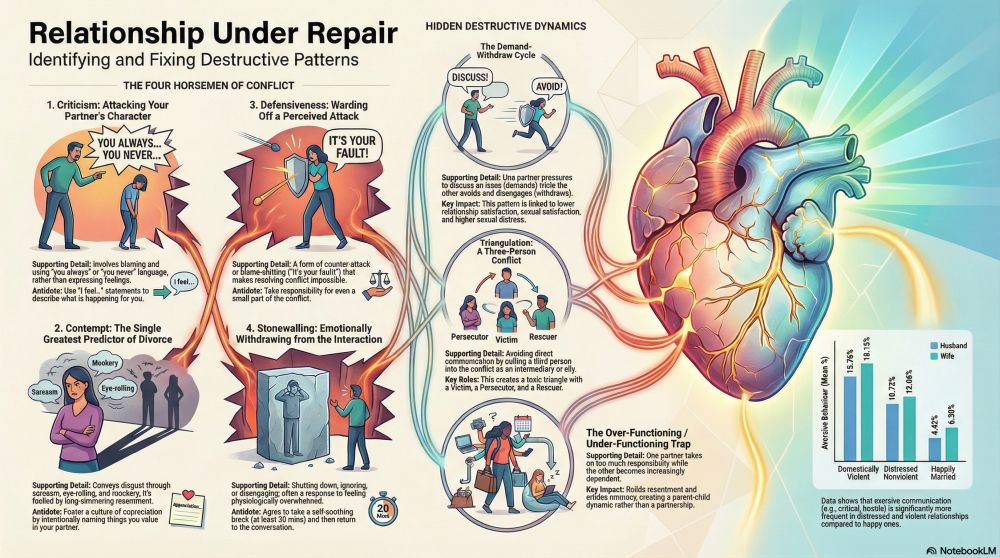
The Impact of Marital Silence
Research on When Silence Hurts vs. Helps Relationships
⚠️ Critical Warning
Habitual silence corrodes connection. Brief pauses calm moments, but persistent stonewalling predicts relationship decline.
Negative Impacts of Habitual Silence (Damage Score)
Helpful vs. Harmful Silence (Effectiveness Comparison)
Evidence-Based Intervention Effectiveness
5:1
Required Positive-to-Negative Ratio During Tough Periods
Build positive bandwidth with appreciations, gentle humor, and affection so conflict isn't all that's left
🛑 Time-Out Script
"I'm getting flooded and might shut down. I need 30 minutes and will come back at 7:30 pm."
🔄 Re-Entry Script
"Thanks for waiting. I can listen now. What feels most important for you to be understood about?"
🔧 Repair Script
"I withdrew earlier. I'm sorry. I want to keep talking and understand your perspective."
20-60 min
Optimal time-out duration to down-regulate before resuming
10-15 min
Daily stress-reducing conversation time (one shares, other validates)
2-3 min
Speaker-listener turn duration for structured hard talks
Days
Stonewalling lasting this long = time to seek professional help
Hover over charts for detailed insights • Replace unmanaged withdrawal with time-limited pauses and clear signaling
Marital silence—when spouses withhold emotional or verbal communication—has a significant impact on relationship satisfaction. Persistent silence leads to emotional distance, misunderstandings, and reduced marital quality.
Effects on Communication
- Breakdown of emotional and verbal exchange: Ongoing lack of communication fosters isolation and suppression, driving loneliness and dissatisfaction.
- Demand–withdraw patterns: One partner pushes for dialogue while the other shuts down. This cycle raises distress and erodes satisfaction; self-silencing is especially damaging.
- Conflict management costs: Brief silence can cool tempers, but habitual withdrawal blocks repair and deepens misunderstanding.
Health and Emotional Consequences
- Negative affect spillover: Avoidance and stonewalling amplify negative emotions and predict poorer relationship outcomes.
- Physiological toll: Unresolved conflict with silence maintains elevated arousal, which is linked to slower recovery and higher stress load.
- Attachment insecurity: Repeated silence signals unavailability, increasing anxiety or detachment over time.
Impacts of Marital Silence
- Reduced intimacy: Less sharing → fewer positive moments → declining closeness.
- Poor problem-solving: Issues go underground, resurface bigger, and become harder to fix.
- Meaning errors: Partners fill gaps with negative assumptions, fuelling resentment.
- Withdrawal contagion: One partner’s silence often triggers the other’s, creating a stalemate.
When Silence Can Help
- Time-outs: 20–60 minutes to down-regulate before resuming the conversation.
- Mindful pause: Brief internal reset to prevent saying something harmful.
- Listening space: Intentional quiet to let the other finish, followed by reflective summarising.
Evidence-Based Fixes
- Agree a time-out protocol: Safe word, length (e.g., 30 minutes), specific reconvene time. No disappearing acts.
- Use stress-reducing conversations: 10–15 minutes daily where one shares and the other validates (no fixing unless asked).
- Switch from mind-reading to signalling: Say what you feel/need using I-language (“I felt shut out; I need a 10-minute pause, then let’s pick it up at 7:30 pm”).
- Repair attempts: Name the rupture (“I got flooded and shut down”) and the plan (“I’m ready to re-engage now”).
- Structure hard talks: Speaker–listener turns (2–3 minutes each), then joint problem-solve. Summarise agreements in writing.
- Build positive bandwidth: 5:1 positives during tough periods—appreciations, gentle humour, affection—so conflict isn’t all that’s left.
Quick Scripts
- Time-out: “I’m getting flooded and might shut down. I need 30 minutes and will come back at 7:30 pm.”
- Re-entry: “Thanks for waiting. I can listen now. What feels most important for you to be understood about?”
- Repair: “I withdrew earlier. I’m sorry. I want to keep talking and understand your perspective.”
When to Seek Help
- Repeated stonewalling lasting days.
- Important topics never get resolved (money, intimacy, parenting).
- Either partner feels unsafe, unheard, or chronically alone in the relationship.
Bottom Line
Silence can calm a moment, but habitual silence corrodes connection. Replace unmanaged withdrawal with time-limited pauses, clear signalling, and structured conversations. If the cycle is entrenched, bring in a skilled couples therapist; faster repair beats long standoffs.
Mini Action Plan
- Tonight: Share one appreciation; schedule a 10-minute stress-reducing chat.
- This week: Draft a time-out agreement and try speaker–listener once.
- This month: Tackle one avoided topic using the structure; write the agreement you reached.